Businesses can buy gift cards in bulk below face value. What the discount is per brand, why paying by ACH, wire or Zelle adds 3%, how 500 codes reach 500 people, and what the IRS says about employee gift cards.
Yes, a business can buy gift cards in bulk for less than face value. You pay below the amount printed on the card, and the recipient still spends the full amount. A $100 card that cost you $85 is worth $100 at the register.
That gap is the entire mechanism. This guide covers where the discount comes from, what you pay, how the codes reach your people, and the one tax question that catches most buyers out.
Card Depot sells the cards described here, so read this as a vendor explaining its own model. If you want the provenance question settled first, start with how it works and is Card Depot legit. Rates and terms below are current as of August 28, 2026 and they change by brand and availability.
Two-Minute Version
The numbers at a glance, before the detail:
- Discounts are per brand, not a flat rate. The range runs from about 1% on Amazon to 30% on some specialty brands, with most household names between 5% and 15% (Card Depot rates, August 28, 2026).
- Paying by ACH, wire, or Zelle earns an additional 3% discount on top of the brand discount (Card Depot terms, August 2026).
- There is no minimum order size. Business accounts are expected to run about $10,000 per month in volume to stay open. That is an ongoing account level, not a per-order floor.
- Delivery is instant. Order on the site and the codes land in your account. Download them as individual PDFs, or export every code as one Excel file.
- The IRS treats gift cards to employees as cash equivalents. They are generally taxable compensation and cannot be excluded as a de minimis benefit. Budget for that before you buy.
- An API and an employee-choice portal are in development. Neither is available yet.
Where the Discount Comes From
Card Depot buys gift cards in bulk from brands and from companies holding large supplies, then sells them below face value. The margin sits between the bulk purchase price and the resale price. Nothing about the card changes. It carries no expiration date and it spends like any other card from that brand. The longer explanation of the mechanism lives in discount gift cards explained.
The supply model is the difference between vendors. A peer-to-peer marketplace resells cards that individuals no longer want, so provenance varies card by card. Bulk sourcing from brands and large holders means the origin is known. Every purchase also runs an identity verification check, which is a friction point on purpose.
What You Actually Pay
Two discounts stack.
The brand discount
It is set per brand and shown on each brand page. It moves with supply. A brand at 7% this week may sit at 4% next month (Card Depot rates, August 2026).
The payment discount
This is a flat additional 3% when you pay by ACH transfer, wire, or Zelle (Card Depot terms, August 2026). Card payments do not earn it. For a business running five figures a month, this is usually the larger of the two levers you control. You choose the payment rail. You do not choose the supply.
Effective discount by brand, after both discounts
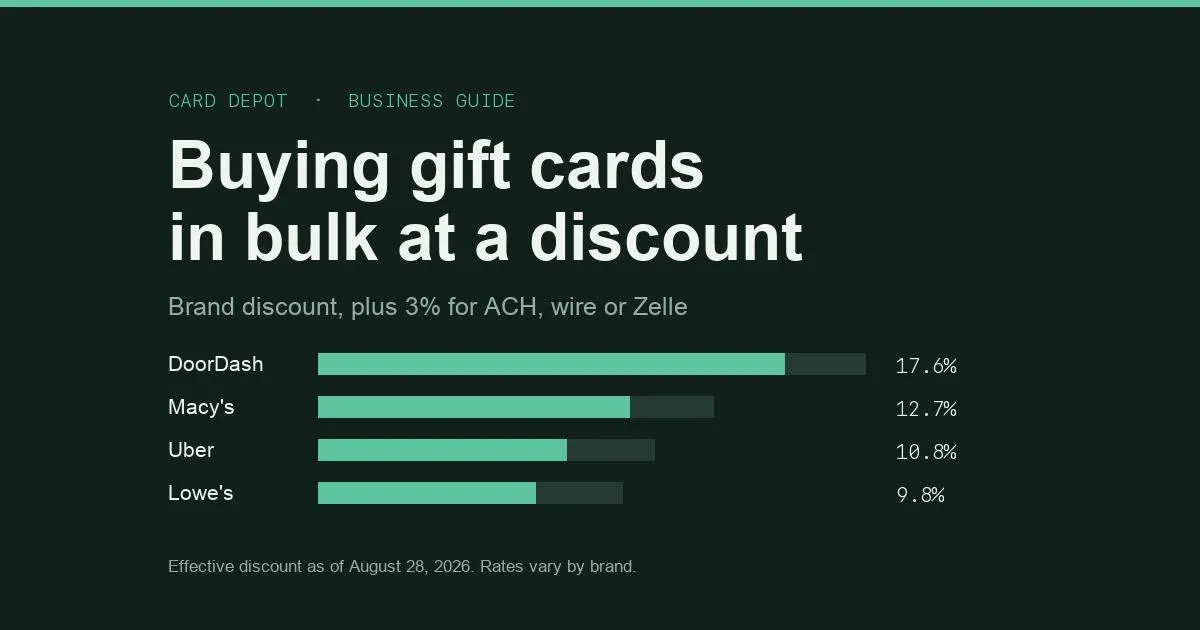
Our team analyzed the published rates for the 4 brands below on August 28, 2026, then combined both discounts into the number that actually hits your invoice. Methodology: every line is a $20,000 face-value order, with the 3% payment discount applied to the amount payable after the brand discount (Card Depot rates, August 28, 2026).
Employees receive the same $100 each in all four cases. Only your invoice changes.
- DoorDash: up to 15% brand discount, 17.6% effective with ACH. You pay $16,490.
- Macy's: up to 10% brand discount, 12.7% effective with ACH. You pay $17,460.
- Uber: up to 8% brand discount, 10.8% effective with ACH. You pay $17,848.
- Lowe's: up to 7% brand discount, 9.8% effective with ACH. You pay $18,042.
The spread between the top and bottom line above is $1,552 on the same $20,000 of employee spending power (Card Depot rates, August 28, 2026). That is the single most useful fact in this guide.
A Real Example: 200 Employees at $100 Each
Say you are buying holiday gifts for 200 people, and you want each person to receive $100 of spending power. Face value is $20,000.
Buying DoorDash at up to 15% off (Card Depot rate, August 28, 2026):
- Face value delivered to employees: $20,000
- At 15% off, you pay: $17,000
- Additional 3% for paying by ACH: $16,490
- Total cost: $16,490. You saved $3,510, an effective 17.6% off.
Run the same order through Lowe's at up to 7% off and you pay $18,042, saving $1,958 for an effective 9.8% off.
Identical $20,000 of employee value, a $1,552 difference in what it costs you. Brand choice is the biggest variable in the whole calculation. Worth settling before you commit to a single brand for an entire program.
How the Codes Reach 200 People
This is where bulk gift card buying usually falls apart. It is worth understanding before you order.
You place the order on the site and the codes are delivered to your account immediately. There is nothing physical to ship and no waiting on fulfillment. From there you have two export routes:
- Individual PDFs, one file per card, suitable for forwarding to a named person, for example a manager handing over a recognition award in person.
- A single Excel file containing every code in the order. This is the route for volume.
The Excel export is the piece that makes large programs practical. It drops straight into tools you already use, such as a mail merge, an HRIS, or an internal recognition platform. You can also hand the file to an AI assistant and have it handle distribution and tracking. A number of buyers now run it that way.
Two things are in development and not available yet. An API for programmatic ordering is being built. So is an employee-choice portal, where your people select their own brand instead of receiving one you picked. Neither has a published date.
If your recipients hit trouble redeeming, the mechanics of partial balances and split payments are covered in how to use gift cards online, and balance checking is covered in how to check your gift card balance.
The Tax Question Most Buyers Miss
If the cards are going to employees, this section matters more than the discount.
The IRS position is explicit. Publication 15-B (2026), Employer's Tax Guide to Fringe Benefits, states:
"Cash and cash equivalent fringe benefits (for example, gift certificates, gift cards, and the use of a charge card or credit card), no matter how little, are never excludable as a de minimis benefit."
In plain terms, a $25 gift card to an employee is not treated the way a holiday turkey or a coffee mug is treated. Those items can qualify as de minimis fringe benefits. Gift cards are cash equivalents, and that exclusion does not apply to them at any value.
This is reporting, not tax advice, and this page is not written by an accountant. The practical point is narrow. Payroll treatment of employee gift cards is a real line item. The number your finance team should model is the fully loaded cost, not the purchase price. Take the specifics to your own accountant before you size the program.
Client and customer gifts fall under different rules than employee compensation, and deductibility limits there are their own subject. Same advice applies.
Separately, state law governs what happens to unused balances, including cash-out rights in some states. That is covered in state laws requiring merchants to cash out gift cards.
Five Ways Businesses Actually Use This
The math changes with the use case.
Employee recognition
Small, frequent, spread across the year. The discount compounds because you are buying continuously rather than once. Watch the payroll treatment above.
Holiday gifting
One large Q4 order. Brand choice matters most here, because a two point difference in discount on a $50,000 program is $1,000.
Client gifts
Lower volume, higher perceived value per unit. Brand prestige tends to matter more than the discount percentage.
Promotional incentives
Sign-up bonuses, survey completions, referral rewards. Here the gift card is a cost of acquisition, so the discount goes straight to your CAC.
Project and facilities supply
Consider construction, maintenance, or an office fit-out. You are buying materials anyway, through Lowe's or an office supplier, so the discount is a direct reduction in project cost with no behavior change required.
The last one is the most overlooked. It is not a gifting program at all. It is procurement.
What Procurement Will Ask
Is there a minimum order?
No. You can start small.
So what is the $10,000?
Business accounts are expected to run around $10,000 per month in volume to stay open. It is an ongoing relationship level, not a barrier to a first order.
Why do you need my identity verified?
Every purchase runs an identity check. In a category with a genuine fraud problem, that is how provenance stays clean on both sides.
What if a code does not work?
Cards carry a 100-day validity guarantee, with replacement for defective cards, set out in full on the guarantee page. The cards themselves do not expire.
Can we get an invoice and terms?
Payment by ACH, wire, or Zelle earns the additional 3%, which tells you which rails are supported. Terms are worth raising directly with the team through contact us.
How fast can we get 500 codes?
Immediately. Order on the site, export the Excel file, distribute.
Frequently Asked Questions
Can a business buy gift cards in bulk at a discount?
Yes. Businesses buy gift cards below face value, with the discount set per brand. Rates range from roughly 1% to 30% depending on the brand, and paying by ACH, wire, or Zelle adds a further 3% (Card Depot rates, August 28, 2026).
Is there a minimum order for bulk gift cards?
No. There is no minimum order size. Business accounts are expected to sustain approximately $10,000 per month in volume as an ongoing account level.
How are bulk gift cards delivered?
Instantly, to your online account. Codes can be downloaded as individual PDFs or exported as a single Excel file containing every code in the order.
Are gift cards to employees taxable?
The IRS treats gift cards as cash equivalents. Publication 15-B (2026) states they are never excludable as a de minimis benefit, no matter how small the amount. Consult your accountant on the payroll treatment.
Do bulk gift cards expire?
The cards themselves carry no expiration date. Purchases are covered by a 100-day validity guarantee with replacement for defective cards.
What is the difference between wholesale gift cards and discount gift cards?
In practice they describe the same transaction: buying gift cards below face value in volume. Wholesale usually implies a business buyer and a larger order, while discount describes the pricing. The mechanism is identical.
Bottom Line
The bottom line: buying gift cards in bulk below face value is a procurement decision, not a promotion. The brand you choose moves the number more than any negotiation does, and the payment rail is the one lever you fully control at a flat 3%.
If the cards are going to employees, model the payroll treatment before you model the discount. If they are going to a facilities or project budget, the discount is simply a lower invoice on spending you had already approved.
Ready to price a specific brand and volume? See the bulk gift card program for business accounts, or check current rates on any brand page. Rates in this guide are as of August 28, 2026 and vary with supply.
About us
Card Depot buys gift cards in bulk from brands and companies holding large supplies, then sells them below face value. It ranked #359 on the 2026 Inc. 5000 and has saved customers over $25 million since 2020 on $200 million of gift cards. More detail sits on how it works and in the FAQ.
Editorial note
Written and fact-checked by the Card Depot team. Rate figures are Card Depot's own published rates on the date shown, and they move with supply. The tax passage quotes IRS Publication 15-B (2026) verbatim and is reporting, not a substitute for advice from your accountant.
Questions about a business account? Start on the bulk program page, or contact us directly.