Some gift cards become one account balance you spend down. Others need the code at every checkout. Which brands pool a balance, which only store the card, and the per-order limits at Target, Home Depot, Southwest and Delta.
Some gift cards disappear into your account and become one balance you spend down over time. Others make you dig out the code at every single checkout. Most people find out which is which after they have already bought the card.
This is the list, sorted by how the card actually behaves once you own it. Card Depot sells the cards described here, so read it as a vendor explaining its own catalog.
Our team checked each of the 19 brands below against that brand's own published help documentation on August 28, 2026, and every limit is linked to its source so you can confirm it. Brands change these rules without notice, so treat this as a snapshot rather than a permanent guarantee.
Two-Minute Version
The numbers at a glance, before the detail:
- There are three models, not two. Pooled balance, stored card, and code-at-checkout. The middle one looks like the first but behaves like the third.
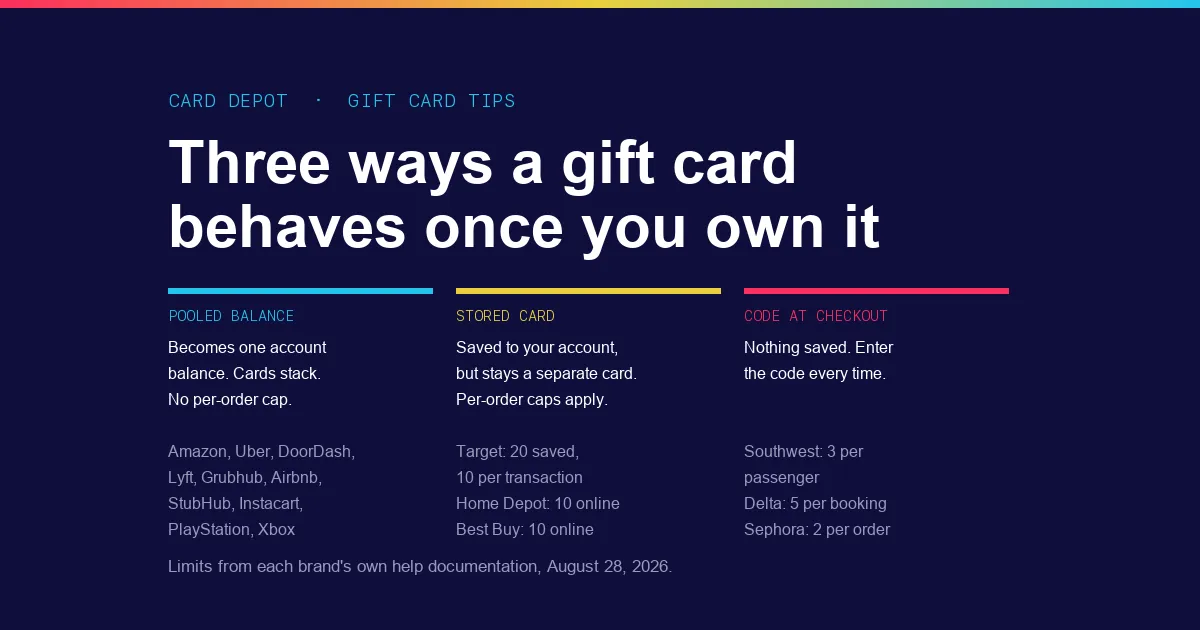
- Pooled balance is the good one. The card dissolves into a single account balance and stacks with other cards, so you select one balance at checkout instead of hunting for codes. Amazon, Uber, DoorDash, Lyft, Grubhub, Airbnb, StubHub, PlayStation, Xbox and Instacart all work this way.
- Target and Home Depot save cards to your account but keep them separate. Target allows 10 per transaction, Home Depot 10 online with reportedly no in-store limit.
- Some big brands do not store cards at all. Southwest allows 3 codes per passenger, Delta allows 5 per booking, and Sephora caps you at 2 per online order with no way to save a card.
- Uber Cash covers rides and Uber Eats interchangeably, and Uber can switch the payment method on a past trip within 30 days, 60 for business trips, so a balance you forgot to use is recoverable within limits.
- If you plan to buy several cards for the same brand, the model decides whether that is effortless or annoying.
The Three Models
Model 1: pooled balance
You enter the code once and the money becomes part of your account. The card stops existing as a separate object. Add five cards and you have one balance, not five cards.
This is the version worth seeking out. There is nothing to track and nothing to retype, and no per-order card limit to run into, because the account sees one balance rather than a stack of cards. You still choose that balance as your payment method at checkout, so check the payment screen on your first order.
Model 2: stored card
The brand saves the card to your account so you do not have to retype the number. That is genuinely convenient. But each card stays a separate card, so you are still selecting individual cards at checkout, and per-order caps apply.
Target and Home Depot both work this way. It reads as "saved to my account" and feels like Model 1 right up until you try to pay with twelve cards at once.
Model 3: code at checkout
Nothing is saved. You enter the number and PIN every time, and you keep the card or the email until the balance runs out.
Brands With a Pooled Balance
These are the ones where the card genuinely becomes account credit.
- Amazon: cards pool into one account balance, selectable at checkout. No limit on how many cards you redeem.
- Uber: redeems into Uber Cash, and the balance is fully interchangeable between Uber rides and Uber Eats. One balance covers both, so a card bought for food works on a ride and the reverse. Up to $1,000 in gift card credits per account. A valid payment method must stay on file, and a card cannot be transferred once added.
- DoorDash: becomes DoorDash credit and combines with any credits you already have, drawn down across orders until it runs out (DoorDash Help Center).
- Lyft: redeems into Lyft Cash, which can be set as your default payment method in Payment settings. Anything above the balance falls to your backup card (Lyft Cash terms).
- Grubhub: balance lands in your account wallet, ready to use on your next order. No limit on how many cards you add. A credit card is still required on file even when the balance covers the whole order.
- Airbnb: multiple cards stack into one credit you apply when you book. Worth knowing: the credit goes against a new booking, not a reservation you have already made (Airbnb Help Center).
- StubHub: redeem into your Wallet and the full balance becomes account credit for your next checkout. Cards never expire (StubHub Support).
- PlayStation: credit goes to your PlayStation Wallet and is drawn on before your card. Codes are region-locked, so a US card only works on a US account (PlayStation wallet support).
- Xbox: the full amount lands in your Microsoft account balance within seconds, spendable on games, Game Pass and the Microsoft Store. Once redeemed it cannot be moved to another account (Microsoft Support).
- Instacart: the full value is credited to your account on redemption, then selected as your payment method at checkout. Cards do not expire (Instacart gift card terms).
Uber lets you fix a trip you already paid for
This one is documented but little known. Uber covers it in a help article titled "Switch the payment method for a past trip."
If you paid for a ride or an order with your card and then remembered you had Uber Cash sitting there, you are not stuck. Open the trip in your history, choose the riding help option, and select the option to change the payment method for a previous trip.
The window is 30 days for personal trips and 60 days for business trips. Two limits matter. It only works if the original trip was paid with an electronic method, meaning a credit or debit card, Uber Cash or PayPal. And you cannot switch to or from Apple Pay, Google Pay, Amex points, or cash.
Within those bounds it turns a mistake into a non-event, and a discounted card can still cover spending you have already done this month.
One habit worth building
Whatever the brand, check the payment screen on your first order after redeeming. A balance sitting in an account is not the same as a balance being used, and the fastest way to pay with a card you already own is to look for it in the payment section rather than assume.
Brands That Save the Card, With Limits
These store the card so you do not retype it, but the cards stay separate.
- Target: save a card to your account with the number and access code. Two separate limits apply. Your wallet holds 20 cards in total, and you can apply 10 per transaction, in store or online (Target help).
- Home Depot: the number and PIN save as a ready-to-use payment option. The 10-card cap is documented for online orders; in store there is reportedly no limit. Only Home Depot cards can be saved this way, and the account stores the card details rather than merging the value into one balance.
- Best Buy: a middle case that leans useful. Cards save to your account and stored balances are available at checkout, but the per-transaction cap is 10 online and 15 in store.
- Starbucks: the interesting one. Cards save to the app individually, but you can merge balances by adding one card to another, which turns several cards into a single balance. It takes a manual step and it is worth doing.
Brands That Do Not Store Cards
Not a criticism, just worth knowing before you buy several.
- Southwest Airlines: a payment method applied at booking, not account credit. A maximum of 3 gift card codes per passenger per reservation. The balance also excludes a long list of extras, including EarlyBird Check-In, vacation packages, and baggage fees.
- Delta: up to 5 gift cards on an original booking at delta.com. Gift cards and eCredits can be combined, but only by phone, not online.
- Sephora: there is no way to save a gift card as a payment method. You enter the card number and PIN in the Payment section at every checkout, and the account only tracks balances. Sephora also publishes a limit of 2 gift cards per online order, which is the tightest cap in this article.
- Lowe's: no account wallet documented. The upside is that there is no published limit on how many cards you can use in a single transaction, which is the opposite trade-off to Home Depot.
Why the Model Matters More Than It Sounds
If you are buying one card, none of this matters much. It matters when you buy more than one, for example when you are covering a month of grocery delivery or stocking up while a brand is discounted.
Say you want $500 of a brand. With a pooled balance, you buy five $100 cards, redeem them in about a minute, and from then on you have a single $500 balance to draw on. With a stored card, you have five separate cards in your wallet and a per-order cap to watch. With code-at-checkout, you have five codes to keep safe and re-enter until each one runs dry.
The same applies to a household or a team. One person can load a pooled balance and everyone spending from that account draws on it, such as a family sharing one delivery account. Stored cards and loose codes do not share nearly as well.
There is a smaller point about waste. A pooled balance absorbs odd remainders, so a $3.17 leftover just sits in the total and gets spent on your next order. A separate card with $3.17 on it tends to be forgotten, and forgotten balances are the single most common way people lose money on gift cards.
How to Check Any Brand Yourself
The list above covers the brands people ask about most, and there are hundreds more in the catalog. Two ways to check one that is not here.
Open the brand's own app or account page. Look for a wallet, a balance, or an "add gift card" option in the payments section. If adding a card there produces a balance figure, it is Model 1 or 2. If the only place to enter a code is the checkout screen, it is Model 3.
Or check the brand page on this site. Each one has a section on how to use that brand's cards and how to check a balance, which usually reveals the mechanism.
As a rough rule that holds more often than not: apps you order through repeatedly tend to pool balances, digital and gaming stores almost always do, large retailers tend to store cards separately, and airlines and cruise lines tend to apply the card at booking only.
Frequently Asked Questions
What does it mean when a gift card loads to your account balance?
The card's value transfers into your account as credit, and the card itself stops mattering. You do not re-enter the code, and the balance shows up as a payment option at checkout. Amazon, Uber, DoorDash, Lyft, Grubhub, Airbnb, StubHub, PlayStation, Xbox and Instacart all work this way.
Can you add multiple gift cards to one account?
For pooled-balance brands, yes, and the balances combine. Amazon and Grubhub publish no limit on the number of cards. Uber caps gift card credits at $1,000 per account. For stored-card brands the limits are tighter: Target holds 20 cards in a wallet and allows 10 per transaction.
How many gift cards can you use at Target in one order?
Up to 10 Target GiftCards per transaction, in store or online. Separately, your Target account wallet can hold up to 20 saved cards in total. The two limits are different and often confused.
How many gift cards can you use at Home Depot?
The 10-card cap is documented for online orders. In store there is reportedly no limit. Home Depot cards can be saved to your account as a payment option, but the account stores each card's details rather than combining them into one balance.
Does an account balance get used automatically?
Do not count on it. Redeeming puts the money in your account, but you should still check the payment section at checkout and select the balance. Some brands pre-select it and some do not, and the behavior varies by app version.
Can you apply a gift card to an Uber trip you already paid for?
Yes, within 30 days for personal trips and 60 days for business trips. Uber documents this in a help article called "Switch the payment method for a past trip." It only works if the trip was paid with an electronic method such as a card, Uber Cash or PayPal, and you cannot switch to or from Apple Pay, Google Pay, Amex points, or cash.
Which gift cards do not save to an account at all?
Among the larger brands, Southwest Airlines allows a maximum of 3 codes per passenger per booking, Delta allows up to 5 on an original booking, and Sephora offers no way to store a card as a payment method and caps online orders at 2 gift cards. Airlines and cruise lines generally apply the card at the point of booking.
Bottom Line
The question is not whether a brand accepts gift cards. It is whether the card becomes a balance you forget about or a code you keep track of.
Pooled balance means buy once, redeem once, then pay from one balance. Stored card means less typing but a cap on how many you can use at a time. Code at checkout means keeping the email until the money is gone.
If you are buying more than one card for the same brand, check which model applies before you buy. It is the difference between a minute of setup and a small ongoing chore.
Browse the full catalog at carddepot.com/brands, or read discount gift cards explained for how the discounts work in the first place. For anything you already own, how to check your gift card balance covers the balance-check route for any brand.
About us
Card Depot buys gift cards in bulk from brands and companies holding large supplies, then sells them below face value. More detail sits on how it works and in the FAQ.
Editorial note
Written and fact-checked by the Card Depot team. Every limit in this article was taken from the brand's own published help documentation on August 28, 2026. Brands change these terms without notice, so verify anything that affects a large purchase. Questions about a bulk or business order go through contact us.